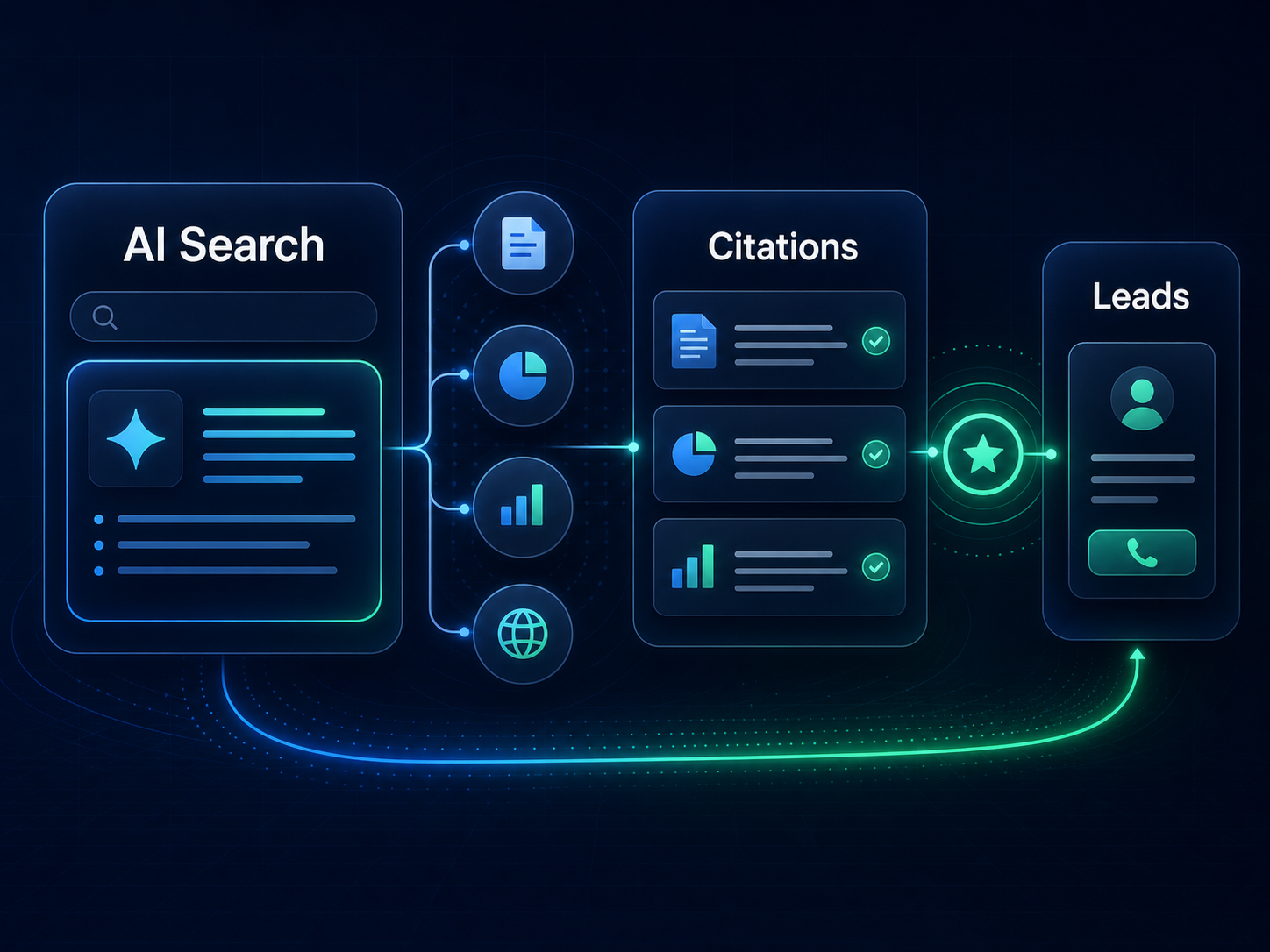
AI Search SEO in 2026: How Businesses Get Mentioned in ChatGPT, Gemini, Claude, Perplexity, and Google AI Results
Search behavior is changing fast. Customers are still using Google, but they are also asking ChatGPT, Gemini, Claude, Perplexity, Copilot, and other AI assistants to compare companies, explain services, shortlist vendors, and recommend next steps.
That does not mean traditional SEO is dead. It means SEO has expanded. A page now has to be understandable to search engines, useful to humans, and structured clearly enough for AI systems to summarize it with confidence.
At Blync.io, we call this AI Search SEO: the work of making your company easier to discover, cite, trust, and contact across modern search experiences.
Why AI search matters for business websites
AI assistants are not only answering simple questions. They are helping buyers make decisions.
A potential customer may ask:
- Who is the best web development agency for a small business?
- What company can build a custom WordPress website and handle SEO?
- Which local SEO agency can help me rank for near me searches?
- What is the difference between AI automation and AI integration?
- Which vendor can handle website, SEO, Google Ads, and ongoing support?
If your website does not clearly explain what you do, who you serve, where you operate, what proof you have, and how your services connect to outcomes, AI systems have less material to work with.
Google’s own guidance says the same SEO fundamentals still matter for AI features in Search: pages should be crawlable, helpful, easy to find through internal links, supported by structured data where appropriate, and available in textual form. Google also notes that pages need to be indexed and eligible to appear in Search to be shown as supporting links in AI features. Source: Google Search Central on AI features.
What AI search engines look for
AI search systems do not simply look for keywords repeated on a page. They need strong signals that help them understand the business.
The strongest signals usually include:
- Clear service pages with specific outcomes
- Helpful FAQ sections that answer real buyer questions
- Case-study style proof, examples, reviews, and measurable results
- Authoritative content around the problems customers search for
- Consistent business information across the website, profiles, and citations
- Structured pages that are easy to crawl, quote, and summarize
- Internal links that connect services, blog posts, locations, and contact paths
For example, a generic page that says “we do digital marketing” gives AI very little context. A stronger page explains that the company provides local SEO, technical SEO, Google Ads, web design, conversion tracking, and lead generation for businesses across the United States.
The second version gives both humans and AI systems a clearer reason to understand the company.
How to optimize for ChatGPT, Gemini, Claude, Perplexity, and Google AI
There is no magic file that guarantees inclusion in AI answers. Google is explicit that there is no special schema required for AI Overviews or AI Mode, and no guaranteed inclusion. But there is a practical playbook.
1. Build pages around buyer questions
Every important service page should answer the questions customers ask before buying:
- What does this service include?
- How long does it take?
- How much does it cost?
- What tools or platforms are used?
- Is this right for my type of business?
- What happens after launch?
- How do we measure success?
These are not just FAQ questions. They are AI answer fuel. If the page gives a direct and trustworthy answer, it becomes easier for search systems to understand the business.
2. Create comparison and decision content
AI assistants are often used for comparison. That means your site should include content such as:
- WordPress vs custom development
- SEO vs Google Ads for lead generation
- Local SEO vs traditional SEO
- AI chatbot vs AI workflow automation
- Website redesign vs new website build
This helps customers who are not ready to buy yet, but are actively researching.
3. Make proof easy to find
AI-generated recommendations are stronger when they can reference proof. Add visible proof across the site:
- Service examples
- Industry examples
- Reviews
- Before and after metrics
- Screenshots or visuals
- Process details
- Clear team expertise
Proof should not be buried on one page. It should appear close to the claim it supports.
4. Use structured, crawlable content
Design matters, but important content cannot live only inside images. Keep your key service descriptions, FAQs, comparison details, pricing context, and proof in real text on the page.
Google’s SEO Starter Guide explains SEO as helping search engines understand content and helping users decide whether to visit. Source: Google SEO Starter Guide.
That same principle applies to AI search. If the page is vague, thin, or hard to crawl, it is harder to use as a trusted source.
AI Search SEO checklist for 2026
Use this checklist to evaluate your website:
- Each service has its own detailed page
- Each page has a clear title, meta description, and first-screen message
- FAQs answer real buyer questions in plain language
- Important services are linked from the homepage and navigation
- Business name, services, location, and contact information are consistent
- Reviews and proof are close to service claims
- Blog posts support the services you want to rank for
- Pages load fast and work well on mobile
- Google Search Console and analytics are connected
- Lead forms, call buttons, and booking CTAs are tracked
The real goal: AI visibility that turns into leads
Being mentioned in AI search is useful only if it creates business outcomes.
That is why we connect AI Search SEO with conversion tracking. We want to know which pages create:
- Organic clicks
- Branded searches
- Form submissions
- Phone calls
- Booked consultations
- Qualified sales opportunities
A website alone does not guarantee leads. Helpful, structured, search-ready content gives customers a reason to find you. Conversion paths give them a reason to contact you.
How Blync.io helps
Blync.io builds AI-search-ready websites and content systems for companies that want more qualified inbound demand.
Our work can include:
- Technical SEO cleanup
- Service page strategy
- AI search visibility content
- FAQ and comparison content
- Structured data review
- Local SEO and Google Business Profile alignment
- Analytics, call tracking, and lead attribution
- Website redesign and conversion optimization
If customers are asking AI tools and Google to recommend companies like yours, your website needs to be clear enough to be understood, trusted, and selected.