Google Ads AI Max and Performance Max in 2026: How to Get Better Leads Without Wasting Budget
Google Ads is changing quickly. Search campaigns are becoming more AI-assisted, Performance Max is getting more controls, and AI Max is becoming a major part of how advertisers expand reach and creative relevance.
For business owners, the question is practical:
Will this create better leads, or just spend more budget?
The answer depends on the system around the campaign.
AI can help find more relevant queries, tailor ad assets, and choose landing pages. But if the website is unclear, the offer is weak, conversion tracking is broken, or sales follow-up is slow, the campaign will still waste money.
What AI Max changes
Google describes AI Max for Search campaigns as an optimization layer for existing Search campaigns. It uses AI-powered features to expand reach, tailor creatives, optimize landing pages, and improve reporting. Source: Google Ads API documentation on AI Max.
Google Ads Help explains that AI Max includes search term matching, asset optimization, final URL expansion, brand controls, location intent controls, URL controls, and improved reporting. Source: Google Ads Help on AI Max.
That matters because search behavior is becoming less predictable. Customers use longer questions, comparison searches, local intent, and AI-assisted discovery.
AI Max can help capture demand that exact keywords may miss. But it also means your website and landing pages become even more important.
Why ads need better landing pages
If Google’s AI can choose more relevant pages from your domain, your domain needs better pages.
A weak website gives the system weak options.
Strong landing pages should include:
- A clear first-screen offer
- The service and target customer
- Proof and trust signals
- Frequently asked questions
- Fast mobile performance
- A simple form or booking flow
- Call tracking where phone leads matter
- Clear conversion events connected to Google Ads
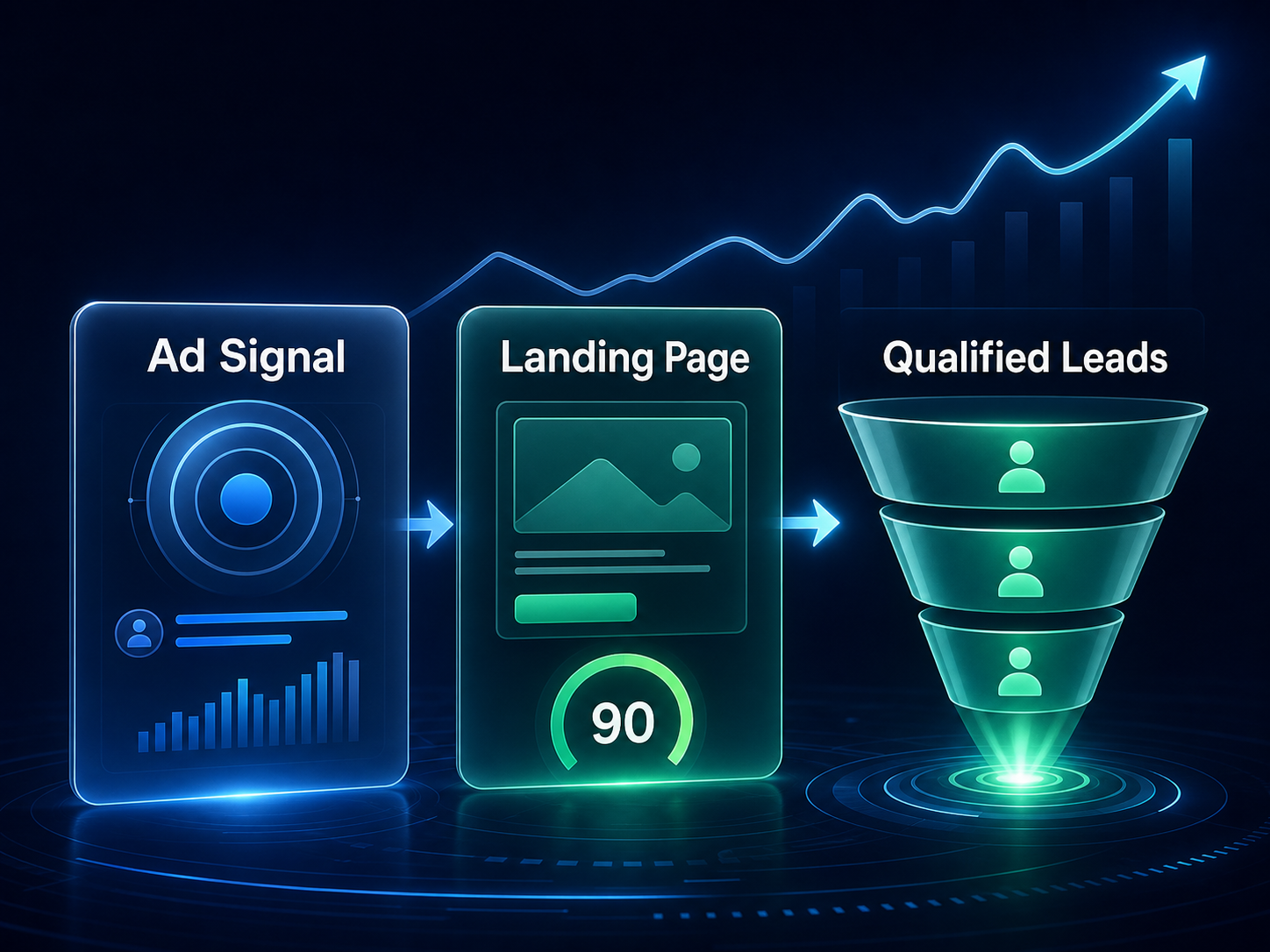
The landing page is not decoration. It is part of the ad system.
The paid search lead pipeline
A healthy Google Ads system usually has five parts:
- Search intent
- Campaign structure
- Ad message
- Landing page
- Lead quality tracking
Most wasted ad spend happens when those parts are disconnected.
For example, a campaign may send traffic to a generic homepage when the searcher wanted a specific service. Or it may optimize toward form fills without knowing which leads became qualified opportunities.
The better approach is to connect search intent to the page and the page to business outcomes.
What to track beyond clicks
Clicks are not the goal. Leads are closer, but even leads can be misleading if quality is low.
Track:
- Cost per lead
- Cost per qualified lead
- Booked calls
- Phone calls from ads
- Form submissions by landing page
- Conversion rate by campaign
- Sales-qualified opportunities
- Revenue pipeline
- Search terms that create real customers
When conversion quality is tracked, Google Ads can be optimized around business value instead of surface-level activity.
AI Max and Performance Max still need controls
Automation works best with guardrails.
In 2026, advertisers should pay attention to:
- Brand inclusions and exclusions
- Location intent controls
- URL exclusions
- Final URL expansion rules
- Asset performance
- Landing page report insights
- Search terms and query themes
- Negative keyword strategy where available
- Offline conversion imports when possible
Google announced that Dynamic Search Ads legacy features are being upgraded toward AI Max, with auto-upgrade timelines shifting into 2026 and 2027 depending on feature type. Source: Google Ads announcement on DSA and AI Max.
The direction is clear: search advertising is moving toward more AI-assisted matching and creative adaptation.
How small businesses should approach Google Ads in 2026
Start with the offer and landing page before scaling budget.
Ask:
- What problem does the customer want solved?
- What page answers that problem best?
- What proof makes the business credible?
- What action should the visitor take?
- What counts as a qualified lead?
- How quickly does the team follow up?
- Which campaigns create revenue, not just form fills?
If those answers are unclear, increasing the budget will usually increase waste.
When Google Ads and SEO work together
Google Ads can create leads faster than SEO, but SEO builds compounding visibility. The strongest growth system uses both.
Google Ads helps you test offers, keywords, audiences, and landing pages quickly.
SEO turns validated demand into long-term organic visibility.
Together, they can reveal which pages deserve more content, which terms deserve dedicated service pages, and which questions customers ask before converting.
How Blync.io helps
Blync.io connects Google Ads management with landing page design, website development, SEO, conversion tracking, and lead quality reporting.
Our Google Ads work can include:
- Campaign structure and account cleanup
- AI Max readiness review
- Performance Max strategy
- Landing page creation or redesign
- Conversion tracking and call tracking
- Lead form optimization
- Search intent mapping
- Monthly reporting focused on qualified leads
The goal is not just more traffic. The goal is better leads at a cost that makes sense.