Local SEO for Near Me Searches in 2026: How to Turn Google Visibility Into Calls, Bookings, and Leads
For many businesses, the highest-intent customer is not searching for a brand name. They are searching for something urgent and local.
They type:
- web design agency near me
- SEO company near me
- app developer near me
- Shopify developer near me
- Google Ads management near me
- best marketing agency in my area
- local business website designer
These searches matter because the customer is already close to taking action. They may call today, book this week, or compare a few companies before choosing one.
Local SEO is the system that helps your business show up when that search happens.
A website alone is not enough
Many businesses launch a website and expect leads to appear. But a website without local SEO is like opening an office without putting the address anywhere.
To generate local leads, your business needs:
- A clear website
- Location and service relevance
- A complete Google Business Profile
- Consistent business information
- Reviews and reputation signals
- Local landing pages
- Helpful content that answers buyer questions
- Conversion tracking for calls, forms, and bookings
The goal is not only ranking. The goal is being chosen.
How Google evaluates local results
Google’s local ranking guidance explains that local results are mainly based on relevance, distance, and prominence.
Relevance means how well your profile and content match the search. Distance means how close the business is to the searcher or searched area. Prominence means how well known and trusted the business appears based on signals such as reviews, links, and web presence. Source: Google Business Profile local ranking guidance.
This is why local SEO is not one task. It is a connected system.
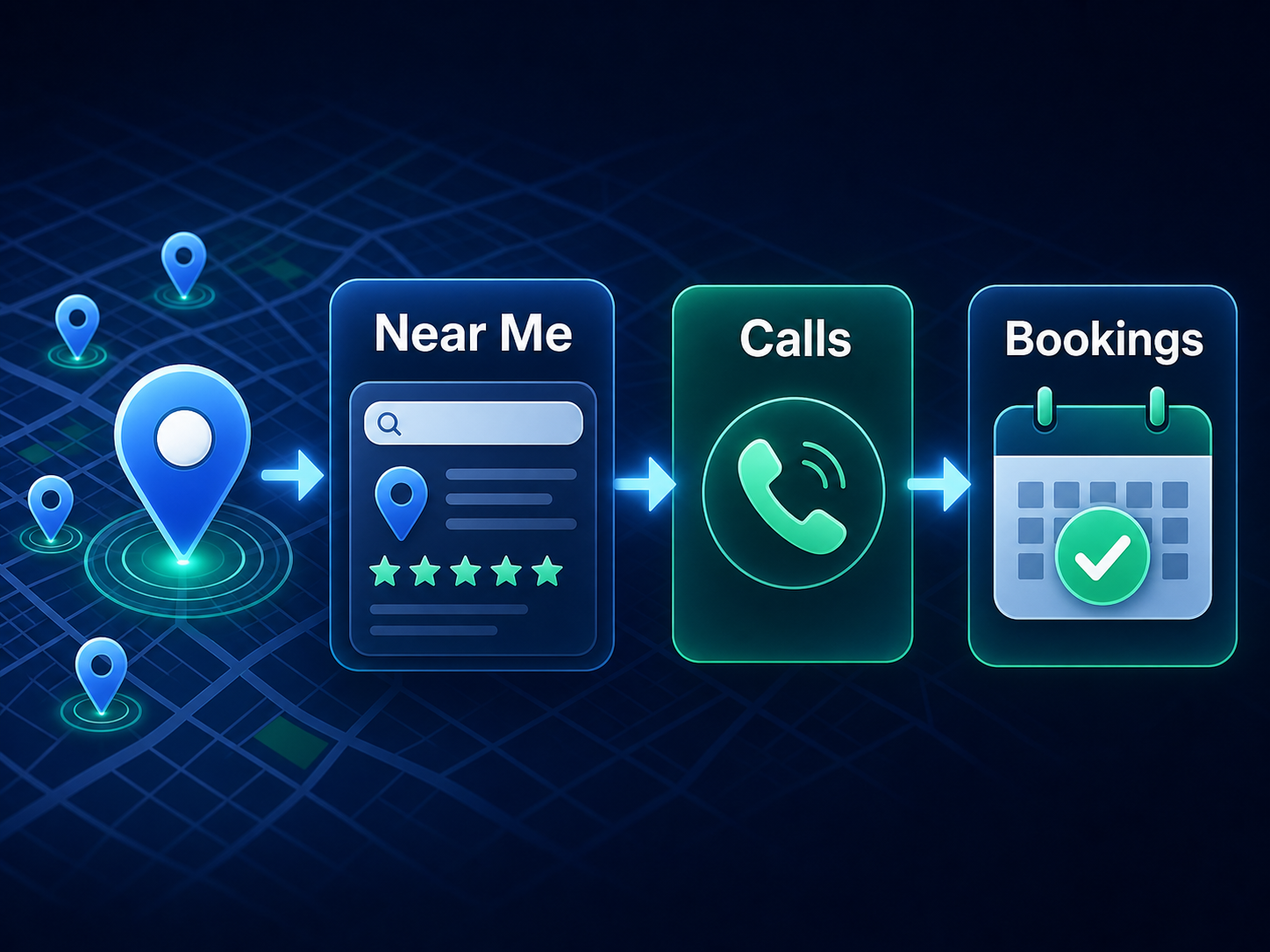
The local SEO lead path
Here is the simplest way to understand it:
Search visibility creates attention.
Attention creates clicks and calls.
Clicks and calls become leads when the website, profile, and offer are clear.
That path usually looks like this:
- Customer searches for a service near them
- Google shows local results, organic pages, and ads
- Customer checks reviews, photos, services, and website
- Customer clicks, calls, or books
- Business tracks which page or profile created the lead
If any part is weak, leads leak out of the funnel.
What to optimize first
1. Google Business Profile
Your Google Business Profile should be complete, accurate, and active.
Make sure it includes:
- Correct business name
- Correct address or service area
- Primary and secondary categories
- Business hours
- Phone number
- Website link
- Service list
- Photos and videos
- Business description
- Products or services where relevant
- Review responses
Google’s guidelines also warn that the business name should reflect the real-world name and not include unnecessary keywords. Source: Google Business Profile guidelines.
Do not stuff keywords into the name. It can create suspension risk and damage trust.
2. Location and service pages
A strong website should support local searches with pages that explain:
- What service you provide
- Who it is for
- Where you provide it
- What problems it solves
- What proof you have
- How to contact you
For example, a page for “web design in San Jose” should not be a thin duplicate of a generic web design page. It should explain the service, local context, industries served, process, and next steps.
3. Reviews and reputation
Reviews influence both trust and local visibility. The best review strategy is not fake volume. It is a consistent process.
Ask real customers after successful work. Respond to reviews. Use feedback to improve service pages. Show testimonials on the website where they support the decision.
4. Conversion paths
Local SEO fails when customers cannot act quickly.
Every important page should make the next step obvious:
- Call button
- Booking button
- Contact form
- Service-specific CTA
- Mobile-friendly navigation
- Fast page speed
If someone searches from a phone, the phone call path should be frictionless.
What local businesses should track
Do not measure local SEO only by rankings. Track business outcomes:
- Local pack visibility
- Organic clicks
- Phone calls
- Direction requests
- Website form submissions
- Booked consultations
- Revenue pipeline by landing page
- Leads from Google Business Profile
- Leads from service pages
- Leads from blog content
When you know which pages create calls and bookings, you can invest in the content that actually grows the business.
Local SEO content ideas for 2026
The best local SEO content answers real customer questions.
Examples:
- How much does a business website cost in California?
- How long does SEO take for a local company?
- Should a small business use Google Ads or SEO first?
- What should be included in a local service website?
- How do near me searches work?
- How do reviews affect Google rankings?
- What is the difference between local SEO and regular SEO?
These topics match the way people search before contacting a company.
How Blync.io helps
Blync.io helps businesses connect local SEO, website design, content, Google Business Profile optimization, conversion tracking, and lead generation.
Our local SEO work can include:
- Website structure and service page planning
- Google Business Profile review
- Local keyword strategy
- Location page creation
- Review and reputation strategy
- Technical SEO cleanup
- Tracking for calls, forms, and bookings
- Monthly reporting focused on leads, not vanity metrics
The goal is simple: when someone searches for a service you provide, your business should be easier to find, easier to trust, and easier to contact.